by Sarajane Giere
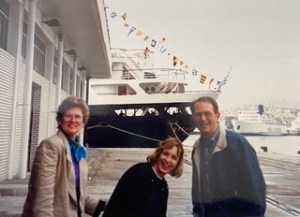 I’d been using the Greek Myths as part of my 6th grade reading program and was drawn to the intriguing country where these myths originated. In 1992, I asked my husband, Bernie and our long-time travel buddies, Sandi and Jim Knoch, if our next trip should be Greece. They loved the idea, especially since our husbands flew for Pan Am which made traveling on our airline passes a pleasure.
At the beginning of my Easter break we flew to the land of the ancients. We were a tight team of travelers. The trip over gave me more time to study the guidebook and choose the museums and ancient sites we should visit. That was my job, while Sandi’s was reserving the ship and local tours. Jim spoke French and Bernie, some pigeon German, and they both handled the money and rented the cars. We’d been around Europe often, but on this adventure, we let our guard down and it almost spoiled our trip.
The four of us spent two wonderful days exploring Athens in the hands of the Hilton’s driver, Peter a smart British chap whose wife was Greek. On our third day, our Mediterranean Cruise ship would be sailing at 3:00, and our plan was to visit the Athens Archeological Museum, then take a cab to the hotel, pick up our luggage and grab a taxi to the port city of Pireas to board our ship, the Stella Oceanis. I couldn’t wait.
At one o’clock, the four of us were having lunch at a café in Athens, across the street from the Athens National Archeological Museum. I didn’t want to miss this one. After a delicious lunch of Moussaka, and a glass of Ouzo, we had fun reliving our recent escapades. Even though the museum was open from 9:00-8:00, we could see there were tourists gathered on the steps because the huge bronze doors were shut. The waiter said the museum employees had gone out on strike and probably wouldn’t open for another hour.
We’d come across these types of mini strikes before in Europe and decided to check out the gift store next door and wait it out. Thirty minutes later, at 1:30, the museum opened, and finally, we’d get to see artifacts from civilizations dating from 7 millennium to around 1050 B.C. Remarkable!
We joined the disgruntled visitors as they poured into the Archeological Museum’s lobby. The museum seemed intimidating at first, with its mob of visitors, long lines, and no directions or labels in English.
Undaunted, I said, “Let’s see if that guide over at the table can give us a personal tour—just the four of us.” Bernie inquired, the fee was reasonable, and we signed on.
“My name is Georgios, “the guide said. He had an engaging smile and buoyant personality that put us at ease. He looked about 50 in his neat, tan uniform. I could see his black curly hair peeping out from under his cap.
Hives of tourists gathered in front of the many exhibits. Georgios abruptly shoved visitors aside as he shuttled us to the first display case. His rudeness embarrassed me at first, but then, we were at his mercy. The crowd reluctantly parted. In the glass case in front of us were sparkling gold objects which had belonged to an ancient queen of Greece.
“See that cup?” Georgios asked. We four nodded our heads yes, and then stared at the small golden wine glass with a delicate stem. People were trying to elbow their way into our huddle, but Georgios wouldn’t let them. “This cup held the queen of Sparta’s TEARS when her baby died!” he told us, searching our faces to see our reactions. I inhaled. Sandi sighed. Jim and Bernie gave each other the eye as if to say, “OK, what’s next?
We followed our leader into the adjoining room where he guided us towards the nearest wall and asked us not to turn around. “Don’t look, yet.”
Georgios stood in the corner facing us, his hands in motion. “In 1926, a fisherman was fishing in the Aegean Sea when he discovered something tangled in his net. What do you think the fisherman found?” His eyebrows creased his forehead as he waited for our answer, but we could only give him our empty-handed look.
Then, came “VIOLA,” and we turned around to face the 6’10” bronze statue of Poseidon God of the Sea, dating from 470-440 BC. The giant stood atop a platform at the center of the room, naked and bearded, his legs set as if he were ready to hurl a discus. His arms stretched out wide as if they once held a great object. I wondered what it could be.
“I think it was a trident, which makes him Poseidon, God of the Sea,” Georgios said, smiling. “Nobody knows,” he continued, “some say it might have been a thunder bolt. He could be Zeus, God of Thunder.”
As we continued our tour, I commented on how well he spoke English. “I know English. My brother lives in Chicago,” Georgios told us. That perked up Bernie’s attention, for he was from Chicago, and the two of them chatted about the windy city until our tour was over 30 minutes later, at 2:00.
I looked at my watch. Time was slipping away; our cruise ship would be sailing in an hour. I reminded my companions, and we finally said a reluctant goodbye to one of the best guides we’d ever had and headed back to the café to grab a quick drink and call a cab. “We’ve plenty of time,” Jim said.
We had a drink while trading impressions of our intrepid guide’s shtick, and agreed that Georgios and Poseidon, God of the Sea won the day.
I turned to look out the café window and noticed it was raining–as if someone had suddenly turned on the shower full blast. The deluge ran along the busy street and lifted the black bags at curbside as they squished into each other, like water balloons.
The waiter brought our bill, and I asked him about the bags. “A trash collectors’ strike,” he said nonchalantly as if this weren’t the first time.
I glanced over and noticed the cafe’s wall clock above the window, and reminded my companions, “Hey, guys, it’s 2:15 and our ship sails in 45 minutes. We’ve got to get to the Hilton and pick up our luggage at the concierge desk and get going.”
Jim and Bernie looked at their watches and headed outside to hail a cab, as Sandi and I paid the tab. We saw our guys from the window as they tried to flag down taxis, but none would stop. The two of us ran out to join them. The rain pelted. We changed corners. Cabs rushed past. Minutes ticked away.
Finally, a cabbie pulled over and made it known in sign language that they would only take one passenger at a time. What?
“It might be they get more fares, that way,” Jim said.
Sandi and I headed back to the café to dry out. Bernie and Jim followed. My heart throbbed at the thought of missing our Mediterranean cruise ship waiting in Piraeus. And then I thought of Peter. “Let’s call the hotel,” I said to Sandi just as the guys walked in. “Maybe he can help us.” Why hadn’t I thought of this before?
Bernie called the Hilton. “They’ll send Peter over with our luggage,” he announced. “He can take us.” Then he turned to me. “Bright idea, Teach.”
After a while our courteous driver appeared in the hotel’s black Mercedes packed with our tightly tucked in luggage. We hailed him like a long lost relative and piled in between our bags.
Off we went to the port of Piraeus to meet our ship, the Stella Oceanis… if it were still there. The drive would take half an hour, but our ship was scheduled to sail in 15 minutes. The rain kept at it. We made small talk as Peter bested the speed limit—if there was one.
He pulled up to the dock and helped us unload our suitcases. The majestic ship loomed ahead. What a relief.
“I’ll meet you on your return and drive you down to Corinth, as we’d planned,” Peter told us. “There’s much to see in Greece.”
“Thank you,” we answered in unison. “See you then.”
Peter, our man of the hour.
As we approached the ship, I noticed passengers standing at the railing pointing down to us, waving and gesturing to each other, and I suddenly realized we were on stage, the tardy ones.
The ship was waiting for us, the four experienced Pan Am world travelers. Ha! They must have been thinking: those naïve American tourists, no raincoats, no umbrellas, making us wait, no sense of time, Tsk. Tsk.
We reached the gangplank, embarrassed but relieved. We’d made it, thanks to my bright idea and our wonderful Hilton driver.

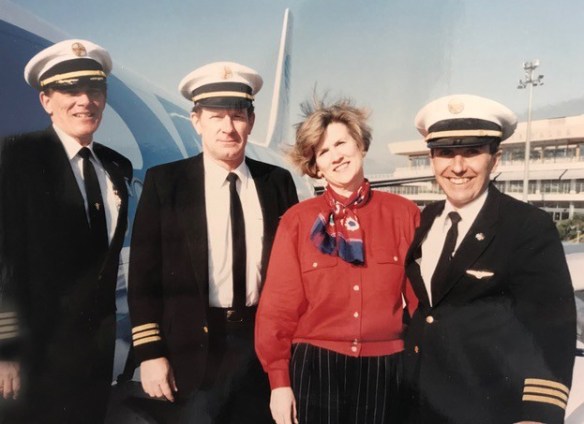
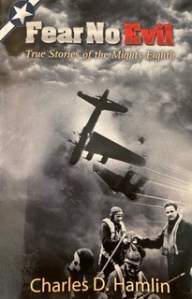 I just finished reading a remarkable book by Charles D. Hamlin, published in 2011 and entitled, “Fear No Evil, True Stories of the Mighty Eight.” Hamlin flew 35 bombing missions in World War II, as a member of the U.S. Army 8th Air Corp, serving as a B-17 ball turret gunner. The average age of a crewmember was 21.
 Bernie and his “Bingle Jells” cake have the last laugh. It was his favorite Christmas greeting, especially to those who hadn’t heard it before. But we, his family had heard it each December, and then some. Boy, was he surprised to see it inscribed on top of a chocolate cake–one made just for him. It’s been 10 years since you’ve been with us my dear Bernard, but our love for you will last forever. Those years since July 31 of 2013 may have rushed on by, but our indelible memory of you remains constant. And isn’t that the way the Lord meant it to be; to leave a light still burning for your loved one who’ll follow in your footsteps?
  While working on a memoir about my grandparents, John and Nannie Palmer, who married in 189I, I found a quip I’d saved by Bill Moyers which seems apropos. “The past is no row of bare facts waiting to be memorized by school children. Nor does it stand in our back yard like an old picket fence, slowly and silently moving. The past is a real world inhabited by villains and heroes and regular folk passing this way on swift journeys. Their story is our story–the tie that binds each generation to all the others.”
 Sarajane Giere