Happy Presidents Day! 

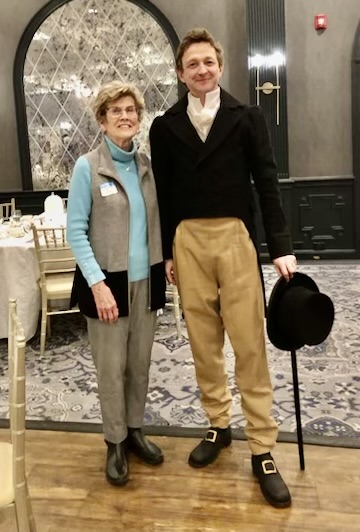
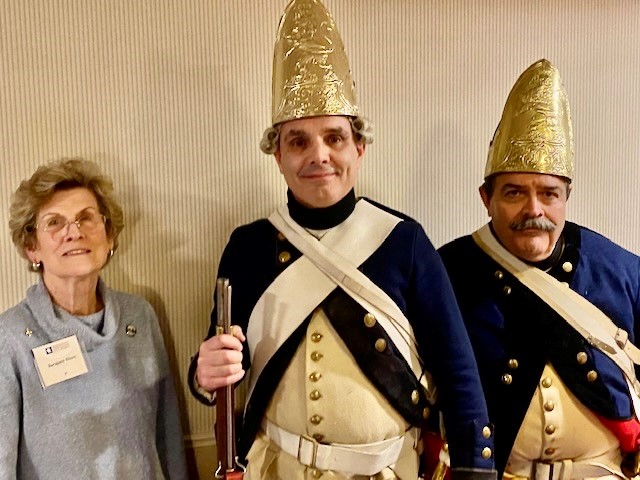
I had the good fortune to visit with the Marquis de Lafayette today, one of my favorite historical characters. He came to the Madison Hotel in Morristown for the 151st annual meeting of the Washington Association of New Jersey, where George Washington’s birthday is celebrated every year. 

Chuck Schwam, Executive Director of the American Friends of Lafayette, gave a lively and illuminating presentation on the life of this remarkable Frenchman who, at age 19, became a Major General in Washington’s Continental Army. 


Save the dates, Sunday, July 13 and Monday, July 14 for a grand celebration to be held in Morristown, NJ, commemorating the 200th anniversary of the General’s visit back to America, and in particular to Morristown, N.J. which took place on Bastille Day. July 14, 1825. Many cities will be celebrating his return. Lafayette came back to America at age 67 and planned to stay three months, but was here for thirteen months! America loved him. See at www.lafayette200.org

Christmas Giving All Year Long

I recently received a Christmas letter from my friend, Cindy Poole, who told a story of giving and gratitude I’d like to share with you:

Dear Friends and Family,

Every year, the recipe for my Christmas Card is about the same: include the true meaning of Christmas, pour in a heaping cup of gratitude, sprinkle in a dash of humor…and I almost always pick on the Wise Men. Inspiration for my 2023 card was long in coming, and I began to think my creative muse had disappeared like a missing sock. But I was inspired by something that happened a few weeks ago.

Typical Saturday morning: I met my friends for our customary breakfast at the BK Diner in West Chester. We sat at our “customary” table surrounded by other Saturday regulars as well as a few folks we did not recognize. In the booth beside us, was a man dining alone, and we struck up a friendly banter with him. After we finished our meals and as we all went digging in our purses for a few extra dollar bills, our server, Kathy, said, “Put your money away. That guy (in the now empty booth) paid your bill.”

WOW! The three college guys in the next booth were incredulous too, and wished aloud that someone would pay their bill. As we were leaving, we did just that and paid their bill. Later, Kathy told us how the students reacted: they paid the bill for someone else. She said there were smiles all around that morning in the diner.

What if we all did that and gave an unexpected gift to someone?  Most likely the receiver would be inspired and grateful, whether he needed it or not. Christmas is about Gifts. The greatest Gift is the birth of God’s son, Jesus Christ. The wise Men brought gifts. Santa teaches children about the joy of giving to others.

ITS ALL ABOUT GIVING. This is the time of year to be grateful to those who bless our lives. You are one of them. Merry Christmas.

Good wishes for good health and happiness in the new year!

ALS Dinner

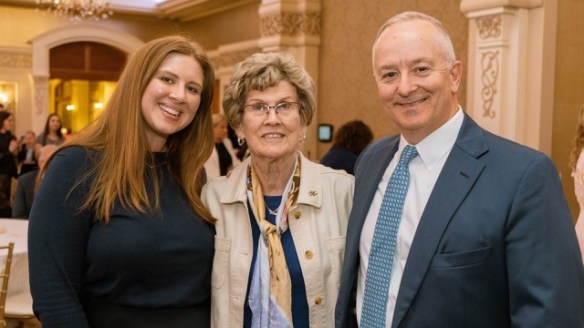
I was delighted to attend the Annual Honoree Banquet given by the ALS Ride for Life organization on Long Island. My son-in-law Tom Conigliaro is on my left and my granddaughter, Shannon Giere, on my right.

I’m standing with Tom Conigliaro at their silent auction table, and guess who’s with us in spirit?  Yes, the photo honors Bernie Giere who died 10 years ago, but who is still remembered by this wonderful group. The event highlighted photos all those former PALS (People with ALS) who had been helped by this great organization.

Won’t you help in finding a cure for ALS? 

Link: Rideforlife.networkforgood.com

Lou Gehrig Day – June 2, 2023

Author, Jonathan Eig said of baseball great, Lou Gehrig:

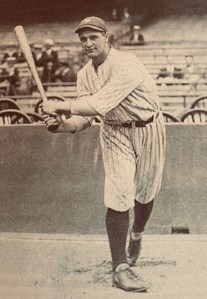
“ALS is a disease of weakness, but Lou Gehrig’s disease is associated with strength—the strength of a dying man who said he felt lucky.” He wrote that Lou’s heroism transcended the game. After Lou was stricken with ALS, and in the weeks that followed his famous goodbye speech, he received over 30,000 letters of support.

June 2, was designated as Lou Gehrig Day in 2002. It’s the date on which he became the Yankees starting first baseman and the day he died from ALS in 1941. He was only 38 years old. ALS breaks down nerve cells in the brain and spinal cord that make muscles work, leading to progressive paralysis and death.

One way to honor Lou and show you care is to donate to ALS. Help defy the odds by contributing to ALS Ride for Life, an organization which supported us when Bernie was stricken with this heartbreaking disease in 2012. Families living with ALS need to know someone out there supports finding a cure.

ALS Ride for Life
c/o Stony Brook University, HSC, L2, Room 106
Stony Brook, NY 11794-8231


The Spirit of Nursing Memorial

On the last Monday in May, when Memorial Day arrives each year, I always remember the day Bernie and I were attending my cousin’s funeral at Arlington National Cemetery. James A. Palmer had been an Admiral in the U.S. Coast Guard, and this was my first visit to the historic national cemetery, our nation’s first. I was overcome with a sense of humility and pride to see 400,000 tombstones of veterans and their dependents lined up like soldiers, row upon row.

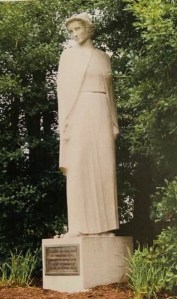
We were driving slowly behind my cousin’s casket which was carried on a Caisson driven oh so slowly by two horses when I noticed a section off to our left, and a tall white marble statue of a woman in a long cape and dress. Bernie and I stopped on the way back to examine this unique site. We found a bronze plaque beneath the statue read, “This monument was erected in 1938 and rededicated in 1971 to commemorate devoted service to country and humanity by Army, Navy and Air Force Nurses.”

The 11’ tall statue of white marble was created by sculptress Frances Rich in an art deco classicism style, and it represents the “Spirit of Nursing.” She seems to gaze reverently upon the 653 deceased nurses that lie before her.

I’d never met an army nurse until several years later, when I had the pleasure of meeting a nurse veteran at an American Legion Hall in Hampton Bays, where Bernie was speaking. I sat next to her in the audience and at first, she gave me pause. Here was a little bit of a gal, hunched over a wheelchair like a flower beat down from the rain. At second glance I noticed her wispy, white hair, how wave it lay, and the angle of her jaunty, red scarf, and I wondered if in her portrait I saw a trace of a style that once defined her as a pretty, young nurse. After Bernie was finished speaking, I moved closer to her and introduced myself. A little flower petal no more, she blossomed, turned toward me, shook my hand, and began to tell me about herself.

Mary Louise graduated from Mt. Sinai nursing school, went to college and nursing school, then joined the Army as a 2nd Lieutenant and worked for a while at Pilgrim State Hospital, where she found it difficult dealing with soldiers with Post Traumatic Stress Syndrome. “They just threw themselves out the windows,” she said. “I knew that I couldn’t go on doing that, none of us were prepared. The war was on, with D-Day still ahead and the persistent problem of PTSD hadn’t been covered in nursing school, nor anywhere else, either, as far as I know.”

A sympathetic supervisor found her a spot with a unit of nurses from Indianapolis, who would be sailing from New York on the Leviathan to East Anglia, 80 miles north of London. She met the other nurses at the dock and was happy to hear her ship was the Leviathan because her mother had taken her to see the impressive ship enter New York on its maiden voyage years before. By the time they landed in England, the nurses knew each other well, and were attached to the 82nd airborne, “That proud contingent of paratroopers that played such a pivotal role in the war,” she said.

“I’m a veteran and a widow of a veteran,” she added, “and I’m a member of the local VFW and the American Legion.” Mary Louise said the local paper had written an article about her. Oh, how wanted to learn more about her duties with the paratroopers, but time ran out. And as we left, I knew how lucky I was to have met this special lady, if only briefly; a woman who served her country during World War II and lived to talk about it.

Our war veterans, both men and women, have stories to tell that are a priceless part of our history, experiences that should be written down or recorded, lest they be lost forever.

On December 15, 2000, the U.S. Congress officially designated 3:00 p.m. local time on every Memorial Day, for all Americans, voluntarily and informally, to observe in their own way a moment of remembrance and respect, pausing from whatever they are doing for a moment of silence or listening to Taps.

The next time you watch a Memorial Day Parade, or hear Taps played, don’t forget to remember the nurses who played such a vital role in supporting our military personnel. That’s the least we can do.


Happy Mother’s Day, Grandma

When I began examining the piles of memorabilia I received from my cousin after my grandparents died, I discovered their memoirs and love letters from the late 1880s. The piles of newspaper articles, diaries, and photographs, led to even more gems. Hours of treasure hunting lay before me.

Grandma Palmer’s cookbook caught my eye. Worn out, but still alive it was full of all sorts of recipes and notes about homemade medicine concoctions and handy household hints a mother of four needed in-order to survive the rigors of child raising and housekeeping. She knew the Treatment for Worms and wrote it in pen, with a footnote: This prescription is used by U.S. Army Medical Faculty in the Philippines.

Brevity was one of her virtues. Warts disappear if you take garlic-parsley tablets. To make pretty walls, put pumice in the paint. Take saffron tea to clean kidneys. When I read her Recipe for Producing Eggs, written with a practiced hand, I had to laugh. I never thought chickens needed help, but I suppose they did.

Grandpa John called Grandma, Nannie, although her name was of Nancy Jane.  I noticed on their 1891 marriage license he’d tried to erase her name and write Nannie above it, but she crossed that out and corrected it…and him. She also assisted him when he became a doctor on horseback, mixing and labeling the medicines and inserting them into his saddlebags. Nannie ran their mercantile store when Grandpa John attended law school in another state, and she never once refused to help a neighbor who was in trouble.

Mothering meant no one was excluded from her love and care, not even when her sister Daisy Chester died, and she and Grandpa took in their 10-year-old nephew, Jesse, and raised him as their son until he joined the army. She and Grandpa also welcomed their oldest daughter Burleigh back into their home after she was divorced. Her two sons were like little brothers to my dad–the youngest Palmer child, and only boy.

Nannie was 70 years old and grey haired when I was born. Reading her memoirs gave me the gift of seeing her as she saw herself as a child, and as a young wife and mother—the grandmother I’d never known. How happy it made me to discover something we had in common: She’d been a teacher and so was I.

Nannie never talked about her past but always seemed interested in everyone else’s life.  She died when I was 13. Hers was the first funeral I ever attended; I was overwhelmed by all those people crowding into the funeral parlor, saddened by the loss of a great lady who died at 83. 

Among her papers I found a Mothers’ Day telegram she had saved, dated 1942. It was from Jesse.

To Mrs. J.W. Palmer, 901 South Vermont, Sedalia, Missouri

TO SOMEONE’S MOTHER, NOT MY VERY OWN, BUT ONE OF THE NICEST I’VE EVER KNOWN.

March, Women’s History Month

A Salute to Aunt Hazel and the BEEPS

I am writing about my dad’s family, the Palmers, from Sedalia, Missouri, and am amazed at the treasures I’ve found among the memorabilia I inherited. I’m sifting through stacks of articles, journals, newspaper articles, photos and memoirs dating from 1888-2002, a remarkable journey of discovery which I consider a blessing. 

Hazel was one of my dad’s 3 older sisters, the one who read aloud to him from the silent movie screens of the day when he had to sit on her lap to see the action. She was an unforgettable person then just as she is now, 21 years after her death.  

I remember the first time I heard Aunt Hazel give a speech. It was during her senatorial campaign 1958. She was the first woman from Missouri to ever seek national office, the U.S. Senate. There was only one woman serving there at the time, Margaret Chase Smith of Maine. 

It was in late summer when she spoke in my hometown, St. Louis.  I was 18, soon to head off to college as a freshman, and my aunt was a perky 54, speaking to an enthusiastic audience at the Chase Hotel ballroom, which I thought was an elegant backdrop for her.

Hazel wasn’t intimidated about running against a Democrat incumbent, Senator Stuart Symington.  “He’s a millionaire, a former Secretary of the Air Force, and I say, so what? Being Secretary of the Air Force makes him vulnerable and I can hardly wait to get to those vulnerable spots.” She didn’t have a chance, however, because he refused to debate her.

Miss Palmer the candidate, astonished me at the podium with her command of serious topics such as the strength of our country’s military capabilities, which she felt was being outpaced by the Russians. (The Soviets had launched Sputnik, the first artificial satellite to orbit the Earth, in October of 1957.) Hazel had once pointed out that the sputniks and nuclear weapons that any enemy might achieve in the long run, won’t be what destroys America. “It will be our lack of courage, self-reliance, and inner faith,” she said. 

Hazel projected energy and vitality when she spoke, as she had done often throughout the U.S. and Europe as national president of the Federation of Business and Professional Women’s Clubs of America. The well- known national organization, named the BPW, listed 175,000 members. When I was a kid, I used to refer to them as The Beeps. 

I never thought Aunt Hazel would lose the Nov. 2nd election, but she did. She had beaten three men to win the primary and seemed invincible to me. It was a doubly painful loss, as her father, my grandpa, John Palmer, died the night before the election, at age 93.  A lifetime lawyer and a former U.S. Congressman, he was hoping to cast a vote for his daughter, but it was not to be. 

During her long, formidable career, Hazel campaigned to guarantee women’s legal rights. The Equal Rights Amendment was first introduced in Congress in 1923 and was kept alive through the years by enthusiasts like Hazel, who knew that legislation was the only way to guarantee permanency.  She was instrumental in getting it added to the Republican Party platform at two of their national conventions which helped to keep it in the limelight during the 50s and 60s.

Three fourths (38) of the states had to ratify the ERA, and there were many “protectionists” who were against it. As time passed, the amendment was reintroduced in Congress year after year to no avail. Today, the ERA still has not been formally instated as the 28th Amendment of our Constitution, but in 2020, it moved closer to its goal.    

Hazel served on committees of three presidents, Eisenhower, Nixon, and Reagan. Among her papers, I’ve found telegrams, invitations, and letters from those former presidents, and it gives me a rush just to hold them as I slide them to plastic sheets for preservation. Hazel possessed a personal charm and gracious spirit which endeared her to all who knew her. 

Aunt Hazel was in law practice with my grandpa, John W. Palmer, in Sedalia, Mo.  She eventually became a judge and died in 2002, at the age of 99. Hazel was loving and kind–my inspiration, a woman who championed women’s rights before it became fashionable. 

My Aunt lived a long life but never married. When asked “Why?” by a reporter, she said, “Mister Right just never came along.”

A colleague remarked upon her retirement, “Judge Palmer set an example of female initiative and activity that would amaze the most energetic corporate CEO today.” When I read that, I wondered what man could ever have kept up with her. 

Celebrating George Washington’s 291st Birthday

On President’s Day, February 20, I attended the 149th Annual Meeting of the Washington Association of New Jersey, at the Madison Hotel in Morristown. I’ve been a member of this organization since I moved to New Jersey in 2014.

At the luncheon, I met a friendly group of Hessians who came to hear the guest speaker, Friederike Baer, talk about her new book, Hessians: German Soldiers in the American Revolutionary War. Out of the roughly 30,000 Hessians who came to America, approximately 5 to 6,000 settled here after the war.

How grand it was to talk to so many people who stopped by my book table to buy My Pilot during the social hour, before the luncheon commenced. What fun we had! Even George himself appeared to thank members and guests. New Jersey is home base for our country’s rich history of the Revolutionary War period, and I feel blessed to be a member of this notable organization.

HAPPY PRESIDENTS DAY!

Here’s some quotes from two of my favorite presidents.

Lincoln

“Most folks are as happy as they make up their mind to be.”

“Tact is the ability to describe others as they see themselves.”

“All rising to a great place is by a winding stair.”

“Always bear in mind that your own resolution to succeed is more important than any other thing.”

“You can fool all the people some of the time, and some of the people all of the time, but you can’t fool all of the people all of the time.”

Washington

“If the freedom of speech is taken away then dumb and silent we may be led, like sheep to slaughter.”

“Few men have the virtue to withstand the highest bidder.”

“It is better to offer no excuse than a bad one.”

“Worry is the interest paid by those who borrow trouble. Truth will ultimately prevail where there are pains to bring it to light.”

Travels with Bernie, Circle of Life


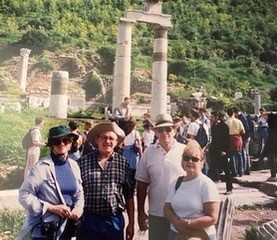
Bernie and I were in Ephesus, Turkey, with Jim and Sandi, when our guide said, “Your Christ is under your feet!” We looked down and discovered a secret code, embedded in the wide, gray paving stones beneath our feet. I imagined that the apostle Paul—who preached on the steps of the amphitheater—walked around it and not over it as I did.

“It’s a pizza with eight slices,” said a boy bending down to touch it.

Our guide explained: “The capital letter I is a vertical line that means Jesus; the X means Christ; the circumference itself with a horizontal line running through it stands for Son; the Y symbolizes God, and the Greek S stands for Savior.”

Since that day, I’ve been more aware of the circles in my life. I think of a family circle of mourners,
who sit around the living room after the funeral. The members take up the slack, pulling the ring taut again.

I consider my church circle of fellowship and Bible study. When I hear Johnny Cash sing, I’m going to join that family circle at the throne,” I think of my loved ones who had preceded me to that glorious circle, and I am comforted.

I think of a round, a cycle, a compass, a halo, and a circle of friends. I think of them all, and especially the undercover Christian who carved the circle of Christ at Ephesus. I thank him for helping me see how our circle of Christianity spans many centuries, languages, and countries.