Celebrating George Washington’s 291st Birthday

On President’s Day, February 20, I attended the 149th Annual Meeting of the Washington Association of New Jersey, at the Madison Hotel in Morristown. I’ve been a member of this organization since I moved to New Jersey in 2014.

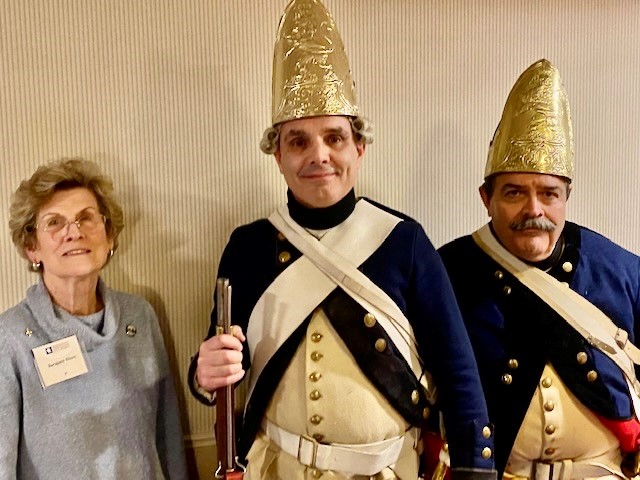
At the luncheon, I met a friendly group of Hessians who came to hear the guest speaker, Friederike Baer, talk about her new book, Hessians: German Soldiers in the American Revolutionary War. Out of the roughly 30,000 Hessians who came to America, approximately 5 to 6,000 settled here after the war.

How grand it was to talk to so many people who stopped by my book table to buy My Pilot during the social hour, before the luncheon commenced. What fun we had! Even George himself appeared to thank members and guests. New Jersey is home base for our country’s rich history of the Revolutionary War period, and I feel blessed to be a member of this notable organization.

HAPPY PRESIDENTS DAY!

Here’s some quotes from two of my favorite presidents.

Lincoln

“Most folks are as happy as they make up their mind to be.”

“Tact is the ability to describe others as they see themselves.”

“All rising to a great place is by a winding stair.”

“Always bear in mind that your own resolution to succeed is more important than any other thing.”

“You can fool all the people some of the time, and some of the people all of the time, but you can’t fool all of the people all of the time.”

Washington

“If the freedom of speech is taken away then dumb and silent we may be led, like sheep to slaughter.”

“Few men have the virtue to withstand the highest bidder.”

“It is better to offer no excuse than a bad one.”

“Worry is the interest paid by those who borrow trouble. Truth will ultimately prevail where there are pains to bring it to light.”

Travels with Bernie, Circle of Life


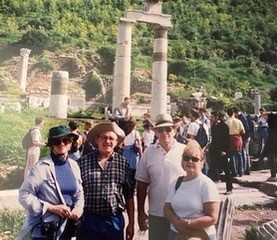
Bernie and I were in Ephesus, Turkey, with Jim and Sandi, when our guide said, “Your Christ is under your feet!” We looked down and discovered a secret code, embedded in the wide, gray paving stones beneath our feet. I imagined that the apostle Paul—who preached on the steps of the amphitheater—walked around it and not over it as I did.

“It’s a pizza with eight slices,” said a boy bending down to touch it.

Our guide explained: “The capital letter I is a vertical line that means Jesus; the X means Christ; the circumference itself with a horizontal line running through it stands for Son; the Y symbolizes God, and the Greek S stands for Savior.”

Since that day, I’ve been more aware of the circles in my life. I think of a family circle of mourners,
who sit around the living room after the funeral. The members take up the slack, pulling the ring taut again.

I consider my church circle of fellowship and Bible study. When I hear Johnny Cash sing, I’m going to join that family circle at the throne,” I think of my loved ones who had preceded me to that glorious circle, and I am comforted.

I think of a round, a cycle, a compass, a halo, and a circle of friends. I think of them all, and especially the undercover Christian who carved the circle of Christ at Ephesus. I thank him for helping me see how our circle of Christianity spans many centuries, languages, and countries.

The Secret of a Partridge in a Pear Tree

XmasBallsWhen I bought twelve hand-painted bulb shaped ornaments in a thrift shop for $ 1.00 I knew I’d found a treasure. The first orb showed a hand painted partridge sitting in a pear tree. The next ornament displayed two turtle doves. The rest followed, each one singing out its merriment to the last of the set: 12 Drummers Drumming.

I thought the Twelve Days of Christmas song was nothing more than a memory game for children and a reminder of the Epiphany—the number of days between Jesus’s birth and the arrival of the wise men. The lyrics didn’t make sense until I researched the song’s true purpose and found what some scholars believe was a secret teaching tool for Catholics, persecuted during the reign of King Henry V111 (1509-1547).

The partridge in a pear tree was Jesus Christ. The two turtle doves were the Old and New Testaments. Three French hens stood for faith, hope and love. The four calling birds were four gospels of Matthew, Mark, Luke, and John.

The five gold rings recalled the Torah or Law, the first five books of the Old Testament. The six geese a laying stood or the six days of creation. Seven swans a swimming represented the sevenfold gifts of the Holy Spirit—Prophesy, Serving, Teaching, Exhortation, Contribution, Leadership and Mercy.

The eight maids a-milking were the eight beatitudes. Nine ladies dancing were the nine fruits of the Holy Spirit—Love-Joy-Peace, Patience, Kindness, Goodness, Faithfulness, Gentleness, and Self-Control. The ten lords a leaping stood for the Ten Commandments. The eleven pipers pipping were the eleven faithful disciples. The twelve drummers drumming symbolized the twelve points of belief in the Apostles’ Creed.

Now, when I sing the song with my 3 -year-old great-granddaughter, I’ll know what it’s all about. Someday, there will come a time when she’ll be able to understand the origin of the popular carol. She’ll then see how fortunate she is to live in a country where we don’t have to disguise our religious beliefs for fear of persecution.

Merry Christmas, everyone.

What’s in a Hat?

I was rearranging my closet shelves last week, making way for my winter sweaters when I spied Bernie’s Pan Am white hat in a plastic bag, on the top shelf. I used a broom handle to gently coax the hat down—my reminder of our Halcyon Days of Yore. 

I buffed the black brim with oil, and straightened the Pan Am world globe insignia. The worn gold braid was still stretched around the black brim and attached by two gold, Pan Am little worlds the size of pennies. Bernie put on his white hat for the first time, 55 years ago. It’s hard to believe, but true. 

In 1967, in airports around the world, travelers knew and respected the Pan Am logo. I imagine they thought those pilots who wore the uniform were handsome, lucky fellows. I thought so, too.

Whenever I’m in an airport, I’m caught off guard when I cross paths with a pilot wearing standard airline attire: white shirt, black tie and trousers, shiny dress shoes, and shoulder chevrons to denote rank: four stripes for Captain, and three for First Officer, the same as Bernie once wore. 

It’s like a wake-up-call as I turn to watch the young man walk on, as Bernie did at 30, carrying his Pan Am flight bag with aplomb, walking on the balls of his feet, as he did on the day we met, when he looked as if he were moving to some jazzy internal tune.

Bernie was glad to be aboard a major airline after he returned from Vietnam. He was accepted by five airlines and decided to sign on with Pan Am, the company he jokingly referred to as, “The World’s Most Experienced”. 

I often think of the drama of Vietnam and what episodes came before the hat.  My history professor once said, War is the only chance a man has, to do something redeeming. I used to think Bernie’s war experiences defined him, but I see now that Vietnam wasn’t his only chance to prove himself; he had many chances after that, and Pan Am was chance number two.

I picked up a crew tag that drifted to the closet floor. It reads: Giere, May 16, destination #1057, Flight A310 F/O; home base JFK, employee number: 12421. I finger it gently and wonder why he saved this tag out of all the others. He’d been furloughed, or laid off, two times in his Pan Am career, and during those times he worked for the New York Air National Guard, never expecting Pan Am to recall again. But they did; it seemed too good to be true.

My Pilot flew for Pan Am again, as well as the Guard, during his days off. I think Bernie saved that little worn out tag because of what it meant to him: after two long furloughs it said: Welcome Back Bernie, We’ve Not Forgotten You, Here’s Another Chance with the World’s Most Experienced. 

The third call back was not a charm. It lasted less than a year. Pan Am went bankrupt, selling their international airplanes and crews to Delta Airlines. Bernie used to say, “I just took off my white hat and put on my black one.” Six years after that, Bernie retired from Delta.

Although carving out a new career in the Air National Guard was satisfying to him–something he was very proud of–Bernie always quipped, when asked about his Pan Am days, “It sure beat working for a living.”

Just in Time

by Sarajane Giere

I’d been using the Greek Myths as part of my 6th grade reading program and was drawn to the intriguing country where these myths originated. In 1992, I asked my husband, Bernie and our long-time travel buddies, Sandi and Jim Knoch, if our next trip should be Greece. They loved the idea, especially since our husbands flew for Pan Am which made traveling on our airline passes a pleasure.

At the beginning of my Easter break we flew to the land of the ancients. We were a tight team of travelers. The trip over gave me more time to study the guidebook and choose the museums and ancient sites we should visit. That was my job, while Sandi’s was reserving the ship and local tours. Jim spoke French and Bernie, some pigeon German, and they both handled the money and rented the cars. We’d been around Europe often, but on this adventure, we let our guard down and it almost spoiled our trip.

The four of us spent two wonderful days exploring Athens in the hands of the Hilton’s driver, Peter a smart British chap whose wife was Greek. On our third day, our Mediterranean Cruise ship would be sailing at 3:00, and our plan was to visit the Athens Archeological Museum, then take a cab to the hotel, pick up our luggage and grab a taxi to the port city of Pireas to board our ship, the Stella Oceanis. I couldn’t wait.

At one o’clock, the four of us were having lunch at a café in Athens, across the street from the Athens National Archeological Museum. I didn’t want to miss this one. After a delicious lunch of Moussaka, and a glass of Ouzo, we had fun reliving our recent escapades.  Even though the museum was open from 9:00-8:00, we could see there were tourists gathered on the steps because the huge bronze doors were shut. The waiter said the museum employees had gone out on strike and probably wouldn’t open for another hour.

We’d come across these types of mini strikes before in Europe and decided to check out the gift store next door and wait it out. Thirty minutes later, at 1:30, the museum opened, and finally, we’d get to see artifacts from civilizations dating from 7 millennium to around 1050 B.C. Remarkable!

We joined the disgruntled visitors as they poured into the Archeological Museum’s lobby. The museum seemed intimidating at first, with its mob of visitors, long lines, and no directions or labels in English.

Undaunted, I said, “Let’s see if that guide over at the table can give us a personal tour—just the four of us.” Bernie inquired, the fee was reasonable, and we signed on.

“My name is Georgios, “the guide said.  He had an engaging smile and buoyant personality that put us at ease. He looked about 50 in his neat, tan uniform.  I could see his black curly hair peeping out from under his cap.

Hives of tourists gathered in front of the many exhibits. Georgios abruptly shoved visitors aside as he shuttled us to the first display case. His rudeness embarrassed me at first, but then, we were at his mercy. The crowd reluctantly parted. In the glass case in front of us were sparkling gold objects which had belonged to an ancient queen of Greece.

“See that cup?” Georgios asked. We four nodded our heads yes, and then stared at the small golden wine glass with a delicate stem. People were trying to elbow their way into our huddle, but Georgios wouldn’t let them. “This cup held the queen of Sparta’s TEARS when her baby died!” he told us, searching our faces to see our reactions.  I inhaled. Sandi sighed. Jim and Bernie gave each other the eye as if to say, “OK, what’s next?

We followed our leader into the adjoining room where he guided us towards the nearest wall and asked us not to turn around. “Don’t look, yet.”

Georgios stood in the corner facing us, his hands in motion. “In 1926, a fisherman was fishing in the Aegean Sea when he discovered something tangled in his net. What do you think the fisherman found?” His eyebrows creased his forehead as he waited for our answer, but we could only give him our empty-handed look.

Then, came “VIOLA,” and we turned around to face the 6’10” bronze statue of Poseidon God of the Sea, dating from 470-440 BC.  The giant stood atop a platform at the center of the room, naked and bearded, his legs set as if he were ready to hurl a discus. His arms stretched out wide as if they once held a great object. I wondered what it could be.

“I think it was a trident, which makes him Poseidon, God of the Sea,” Georgios said, smiling.  “Nobody knows,” he continued, “some say it might have been a thunder bolt. He could be Zeus, God of Thunder.”   

As we continued our tour, I commented on how well he spoke English. “I know English. My brother lives in Chicago,” Georgios told us.  That perked up Bernie’s attention, for he was from Chicago, and the two of them chatted about the windy city until our tour was over 30 minutes later, at 2:00.

I looked at my watch. Time was slipping away; our cruise ship would be sailing in an hour. I reminded my companions, and we finally said a reluctant goodbye to one of the best guides we’d ever had and headed back to the café to grab a quick drink and call a cab. “We’ve plenty of time,” Jim said.  

We had a drink while trading impressions of our intrepid guide’s shtick, and agreed that Georgios and Poseidon, God of the Sea won the day.

I turned to look out the café window and noticed it was raining–as if someone had suddenly turned on the shower full blast. The deluge ran along the busy street and lifted the black bags at curbside as they squished into each other, like water balloons.

The waiter brought our bill, and I asked him about the bags. “A trash collectors’ strike,” he said nonchalantly as if this weren’t the first time.

I glanced over and noticed the cafe’s wall clock above the window, and reminded my companions, “Hey, guys, it’s 2:15 and our ship sails in 45 minutes. We’ve got to get to the Hilton and pick up our luggage at the concierge desk and get going.”

Jim and Bernie looked at their watches and headed outside to hail a cab, as Sandi and I paid the tab. We saw our guys from the window as they tried to flag down taxis, but none would stop. The two of us ran out to join them. The rain pelted. We changed corners. Cabs rushed past.  Minutes ticked away.

 Finally, a cabbie pulled over and made it known in sign language that they would only take one passenger at a time. What?

“It might be they get more fares, that way,” Jim said. 

Sandi and I headed back to the café to dry out. Bernie and Jim followed. My heart throbbed at the thought of missing our Mediterranean cruise ship waiting in Piraeus. And then I thought of Peter. “Let’s call the hotel,” I said to Sandi just as the guys walked in.  “Maybe he can help us.”  Why hadn’t I thought of this before?

Bernie called the Hilton. “They’ll send Peter over with our luggage,” he announced.  “He can take us.”  Then he turned to me. “Bright idea, Teach.”

After a while our courteous driver appeared in the hotel’s black Mercedes packed with our tightly tucked in luggage. We hailed him like a long lost relative and piled in between our bags.

Off we went to the port of Piraeus to meet our ship, the Stella Oceanis… if it were still there. The drive would take half an hour, but our ship was scheduled to sail in 15 minutes.  The rain kept at it. We made small talk as Peter bested the speed limit—if there was one.

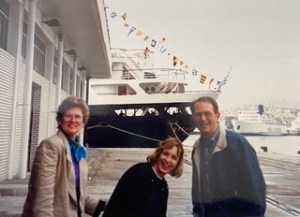
He pulled up to the dock and helped us unload our suitcases. The majestic ship loomed ahead. What a relief.

“I’ll meet you on your return and drive you down to Corinth, as we’d planned,” Peter told us. “There’s much to see in Greece.”

“Thank you,” we answered in unison. “See you then.”

Peter, our man of the hour.

As we approached the ship, I noticed passengers standing at the railing pointing down to us, waving and gesturing to each other, and I suddenly realized we were on stage, the tardy ones.

The ship was waiting for us, the four experienced Pan Am world travelers. Ha! They must have been thinking: those naïve American tourists, no raincoats, no umbrellas, making us wait, no sense of time, Tsk. Tsk.

We reached the gangplank, embarrassed but relieved. We’d made it, thanks to my bright idea and our wonderful Hilton driver.  

A Quip Remembered

While working on a memoir about my grandparents, John and Nannie Palmer, who married in 189I,  I found a quip I’d saved by Bill Moyers which seems apropos. “The past is no row of bare facts waiting to be memorized by school children. Nor does it stand in our back yard like an old picket fence, slowly and silently moving. The past is a real world inhabited by villains and heroes and regular folk passing this way on swift journeys. Their story is our story–the tie that binds each generation to all the others.”

Mission Accomplished in Germany

Even though Bernie flew many Pan Am flights to Germany, the kids and I had never gone along as a family. It was June of 1987, and we thought it was about time to take our kids to meet their European relatives, the Giere’s, of Bremen, Germany. Bernie’s dad, Rudy, said he’d be delighted to be our tour guide. Lisa was a flight attendant with Delta and Paul had just graduated from college. I was teaching and had the summer off. 

Rudy was born in Bremen–an ancient city straddling the Weiser River–and emigrated to Chicago as a young man in 1927. He was happy to show us around his home city and introduce us to his younger brother and 3 sisters and their children. I was fun to see how easily the kids got along with their new cousins, who spoke English, including their parents. Opa’s sisters said he still talked in a perfect northern German dialect, and at 82, he couldn’t have been prouder. 

During our stay in Bremen, Rudy suggested we drive up to Cuxhaven, a favorite vacation spot of the Gieres. His younger brother and three sisters went with us. “We’ll take a walk when we get there,” Rudy said. It sounded good to me, a way to let the food settle. 

At long last we arrived and stepped out onto the wide, paved path along the beach. I was surprised to see so many beachgoers oblivious of the overcast skies and muggy atmosphere. Grown-ups sat in colorful beach chairs, while kids, in various stages of undress, scurried around, hooping, and laughing. 

I thought it could have been any beach in New Jersey or the Hamptons, except for the massive ships I spied in the distance, moving through their sea lanes on their way to port. It made me think of Rudy and how he’d been raised near the water, taking boat trips with his parents as a small boy, and then his significant ocean crossing to America. Rudy had lived in Chicago’s near-north side on Lake Michigan for 66 years, and later moved in with us in our Hamptons home–where he could hear the Atlantic Ocean roar from our front porch.  

The squad in front of us chatted as their pace quickened. I was glad to see Lisa and Paul keeping up in their midst. Bernie and I followed in back, and I kept wondering, Why are they in such a hurry?  The walkway seemed as endless as the sea itself–mile after mile with no end in sight. My feet hurt. At long last, Bernie said, “Let’s catch up,” humoring me along until we joined and linked arms with the others. 

Bernie told me how the Germans love to hike and walk, leisurely, or on a “volksmarch” which is a part of their culture. The spacious path along the sea was full of visitors. I asked Bernie in a whisper, “Why doesn’t our gang slow down to enjoy the view.”

He smiled and said,” They’ve seen it all before, and besides, there’s probably food at the finish line.” 

We passed a line of hotels and finally stopped in front of one and went in for Kaffee and Kuchen (coffee and cake). Bernie was right. It was 4:00, the correct time. I slipped my shoes off under the table, quickly forgetting about my aching feet when our waiter placed before me a piece of Triple-Tiered Black Forest Cherry Cake. How could I resist? It was yummy, and immediately rose to the top of my German Foodie List. Sitting around the big table was a delight. It warmed me up as I watched Rudy, our translator, strive to keep up with our chatter. The hike was worth it, after all. 

On our drive back to Bremen Opa said, “That’s the historical landmark of Cuxhaven, known as the Kugelbake, a beacon once used as a lighthouse.” I gazed out the window at the funny shaped structure and had to laugh at the thought of a lovely place such as this, acclaimed for being like a baked pudding, a “kugel.”   

Our trip ended too soon. I gained a few pounds but after two weeks, I didn’t care one bit. We’d enlarged our family with just one trip to Germany and I was thankful and enriched by the experience. Opa Rudy stayed on for another week.  

When we four took our leave, he said, “How lucky we are, all together in one place, and for the first time.” I hoped it wouldn’t be our last time, but it was, as his brother and sisters eventually died, leaving Opa, the oldest sibling, the only one who emigrated to America, to live on for 20 more years, dying at age 102 in 2007. 

I miss Opa Rudy dearly, and remember all that he taught us, especially about how to overcome obstacles and persevere toward your goal, as he had done so many times during his lifetime. Rudy was going down memory lane as he walked and talked for miles along the North Sea, while shepherding his grandchildren into the flock. Our speed-walking excursion proved to be just as delicious as the desserts that awaited us at journey’s end. Perhaps even better. 

NIGHT MISSION ON THE HO CHI MINH TRAIL

By: Mark Berent 

In honor of all the pilots who’ve courted danger while flying for our country in past wars, I’m sharing with you this essay from the desk of my cousin Mark Berent, author and distinguished fighter pilot who flew over 1,000 combat hours during the Korean and Vietnam wars. Bernie wrote me about flying the Ho Chi Minh Trail, and Mark’s thoughts might give you a good picture of what it was like on the trail at night – Sarajane Giere

It’s cool this evening, thank God. The night is beautiful, moody, an easy rain falling. Thunder rumbles comfortably in the distance. Just the right texture to erase the oppressive heat memories of a few hours ago. Strange how the Thai monsoon heat sucks the energy from your mind and body by day, only to restore it by the cool night rain. 

I am pleased by the tranquil sights and sounds outside my BOQ room door. Distant ramp lights, glare softened by the rain, glisten the leaves and flowers. The straight-down, light rain splashes gently, nicely on the walkways, on the roads, the roofs. 

Inside the room I put some slow California swing on the recorder ( You gotta go where you wanta go…) and warm some soup on the hot plate. Warm music, warm smell… I am in a different world. ( Do what you wanta, wanta do….) I’ve left the door open–I like the sound of the rain out there. 

A few hours later, slightly after midnight, I am sitting in the cockpit of my airplane. It is a jet fighter, a Phantom, and it’s a good airplane. We don’t actually get into the thing–we put it on. I am attached to my craft by two hoses, three wires, lap belt, shoulder harness, and two calf garters to keep my legs from flailing about in a high-speed bailout. The gear I wear–gun, G-suit, survival vest, parachute harness–is bulky, uncomfortable, and it means life or death. 

I start the engines, check the myriad of systems–electronic, radar, engine, fire control, navigation–all systems; receive certain information from the control tower, and am ready to taxi. With hand signals, we are cleared out of the revetment and down the ramp to the arming area. 

I have closed the canopy to keep the rain out, and switch the heavy windscreen blower on and off to hold visibility. I can only keep its hot air on for seconds at a time while on the ground, to prevent cracking the heavy screen. The arming crew, wearing bright colors to indicate their duties, swarm under the plane; electrical continuity–checked; weapons–armed; pins–pulled. Last all-around look-see by the chief–a salute, a thumbs up, we are cleared. God, the rapport between pilot and crew–their last sign, thumbs up–they are with me. You see them quivering, straining, bodies poised forward as they watch their airplane take off and leave them. 

Afterburners ignite, nose wheel steering, rudder effective, line speed, rotation speed–we are off, leaving behind only a ripping, tearing, gut noise as we split into the low black overcast afterburner glow not even visible anymore. 

Steadily we climb, turning a few degrees, easing stick forward some, trimming, climbing, climbing, then suddenly–on top! 

On top where the moonlight is so damn marvelously bright and the undercast appears a gently rolling snow-covered field. It’s just so clear and good up here, I could fly forever. This is part of what flying is all about. I surge and strain against my harness, taking a few seconds to stretch and enjoy this privileged sight. 

I’ve already set course to rendezvous with a tanker, to take on more fuel for my work tonight. We meet after a long cut-off turn, and I nestle under him as he flies his long, delicate boom toward my innards. A slight thump/bump and I’m receiving fuel. No words-all light signals. Can’t even thank the boomer. Suddenly he snatches it back, a clean break, and I’m cleared off and away. 

Now I turn east and very soon cross the ‘fence’ far below. Those tanker guys will take you to hell and then come in and pull you right out again with their flying fuel trucks. Hairy work. They’re grand, gutsy guys. 

Soon I make radio contact with another craft, a big one, a gunship, painted black and flying very low. Like the proverbial specter, he wheels and turns just above the guns, the limestone outcropping, called karst, and the mountains-probing, searching with infrared eyes for supply trucks headed south. He has many engines and more guns. It is an AC-130 gunship, callsign Spectre.

His scanner gets something in his scope, and the pilot goes into a steep bank–right over the target. His guns flick and flash, scream and moan, long amber tongues lick the ground, the trail, and trucks. I am there to keep enemy guns off him and to help him kill trucks. 

Funny–he can see the trucks, but not the guns `til they’re on him. I cannot see the trucks, but pick the guns up as soon as the first rounds flash out of the muzzles. 

Inside my cockpit all the lights are off or down to a dim glow, showing just the instruments I need. The headset in my helmet tells me in a crackling, sometimes joking voice the information I must have . . how high and how close the nearest karst . . target elevation . . altimeter setting . . safe bailout area . . guns, what the other pilot sees on the Trail . . and where he will be when I roll in. 

Then, in the blackest of black, he lets out an air-burning flare to float down and illuminate the sharp rising ground. 

At least then I can mentally photograph the target area. Or he might throw out a big ‘log,’ a flare marker, that will fall to the ground and give of a steady glow. From that point he will tell me where to strike: fifty meters east, or 100 meters south. Or if there are two logs . . hit between the two. I push the power up now, recheck the weapons settings, gun switches, gunsight setting, airspeed, altitude. 

Roll in. Peering, straining, leaning way forward in harness, trying so hard to pick up the area where I know the target to be–it’s so dark down there. 

Sometimes when I drop, pass after pass, great fire bursts upward and a large, rather rectangular fire will let us know we’ve hit another supply truck. Then we will probe with firepower all around that truck to find if there are more. Often we will touch off several, their fires outlining the trail or truck park. 

There are no villages or hooches for miles around; the locals have been gone for years. They silently stole away the first day those big trucks started plunging down the trails from up north. 

But there are gun pits down there–pits, holes, reveted sites, guns in caves, guns on the karst, guns on the hills, in the jungles, big ones, little ones. 

Many times garden-hose streams of cherry balls will arc and curve up, seeming to float so slowly toward me. Those are from the smaller caliber, rapid-fire quads; and then the big stuff opens up, clip after clip of 37-mm and 57-mm follow the garden hose, which is trying to pinpoint me like a search light. Good fire discipline–no one shoots except on command. 

But my lights are out. And I’m moving.

The master fire controller down there tries to find me by my sound. His rising shells burst harmlessly around me. The heavier stuff, in clips of five and seven rounds, goes off way behind. 

Tonight we’re lucky–no “golden BB, ” the one stray shell that gets you. 

Not always so lucky. One night we had four down in Death Valley– that’s just south of Mu Gia Pass. Only got two people out the next day, and that also cost a Sandy (A-1) pilot. “And if the big guns don’t get you, the black karst will,” goes the song. 

Soon I have no more ammunition. Spectre and I, gravely thank each other, and I pull up to thirty or so thousand feet, turn my navigation lights back on, and start across the fence, the Lao border to my home base. In spite of an air-conditioning system working hard enough to cool a five-room house, I’m sweating. I’m tired. My neck is sore. In fact, I’m sore all over. All those roll-ins and diving pullouts, jinking, craning your head, looking, always looking around, in the cockpit, outside, behind, left right, up, down. But I am headed home, my aircraft is light and more responsive. 

Too quickly, I am in the thick, puffy thunder clouds and rain of the southwest monsoon. 

Wild, the psychedelic green, wiry, and twisty St. Elmo’s fire flows liquid and surrealistic on the canopy a few inches away. I am used to it–fascinating. It’s comforting, actually, sitting snugged up in the cockpit, harness and lap belt tight, seat lowered, facing a panel of red-glowing instruments, plane buffeting slightly from the storm. 

Moving without conscious thought, I place the stick and rudder pedals and throttles in this or that position–not so much mechanically moving things, rather just willing the craft to do what I see should be done, by what the instruments tell me. 

I’m used to flying night missions now. We “Night Owls” do feel rather elite, I suppose. We speak of the day pilots in somewhat condescending tone. We have a black pilot who says, “Well, day pilots are OK, I guess, but I wouldn’t want my daughter to marry one.” We have all kinds; white guys, jokey guys (the Jewish pilot with the fierce black bristly mustache who asks, “What is a nice Jewish boy like me doing over here, killing Buddhists to make the world safe for Christianity?“), noisy guys, scared guys, whatever. But all of them do their job. I mean night after night they go out and get hammered and hosed, and yet keep right at it. And all that effort, sacrifice, blood going down the tubes. Well, these thoughts aren’t going to get me home. This is no time to be thinking about anything but what I’m doing right now. 

I call up some people on the ground who are sitting in darkened, blacked-out rooms, staring at phosphorescent screens that are their eyes to the night sky. Radar energy reflecting from me shows them where I am. I flick a switch at their command and trigger an extra burst of energy at them so they have positive identification. 

By radio they direct me, crisply, clearly, to a point in space and time that another man in another darkened room by a runway watches anxiously. His eyes follow a little electronic bug crawling down a radar screen between two converging lines. His voice tells me how the ‘bug’ is doing, or how it should be doing. In a flat, precise voice the radar controller keeps up a constant patter–“Turn left two degrees…approaching glide path…prepare to start descent in four miles.” 

Inside the cockpit I move a few levers and feel the heavy landing gear thud into place and then I counteract the nose-rise as the flaps grind down. I try to follow his machine-like instructions quite accurately as I am very near the ground now. More voice, more commands, then a glimmer of approach lights, and suddenly the wet runway is beneath me. 

I slip over the end, engines whistling a down note as I retard the throttles, and I’m on the ground at last. 

The runway is heavy with rain. I lower a hook to snatch a cable laid across the runway that connects to a friction device on each side. The deceleration throws me violently into my harness as I stop in less than 900 feet from nearly 175 miles per hour. And this is a gut- good feeling. 

Then the slow taxi back, the easing of tension, the good feeling. Crew chiefs with lighted wands in their hands direct me where to park; they chock the wheels and signal me with a throat-cutting motion to shut down the engines. Six or seven people gather around the airplane as the engines coast off, and I unstrap and climb down, soaking wet with sweat. 

You OK ? How did it go? See anything, get anything?” They want to know these things and they have a right to know. Then they ask, “How’s the airplane? “That concern always last. We confer briefly on this or that device or instrument that needs looking after. And then I tell them what I saw, what I did. They nod, grouped around, swear softly, spit once or twice. 

They are tough, and it pleases them to hear results. 

The crew van arrives, I enter and ride through the rain–smoking a cigarette and becoming thoughtful. It’s dark in there, and I need this silent time to myself before going back to the world. We arrive and, with my equipment jangling and thumping about me, I enter the squadron locker room, where there is always easy joking among those who have just come down. 

Those that are suiting up are quiet, serious, going over the mission brief in their minds, for once on a night strike they cannot look at maps or notes or weapon settings. 

They glance at me and ask how the weather is at The Pass. Did I see any thunder-storms over the Dog’s Head? They want to ask about the guns up tonight, but know I’ll say how it was without their questioning. Saw some light ZPU (automatic weapons fire) at The Pass, saw someone getting hosed at Ban Karai, nothing from across the border. Nobody down, quiet night. Now all they have to worry about is thrashing through a couple hundred miles of lousy weather, letting down in instruments and radar into the black karst country and finding their targets. 

Each pilot has his own thought on that. 

Me, I’ll start warming up once the lethargy of finally being back from a mission drains away. Funny how the mind/body combination works. You are all hyped just after you land, then comes a slump, then you’re back up again but not as high as you were when you first landed. By now I’m ready for some hot coffee or a drink (sometimes too many), or maybe just letter writing. A lot of what you want to do depends on how the mission went. 

And so it goes–for a year. And I like it. But every so often, especially during your first few months, a little wisp of thought floats up from way deep in your mind when you see the schedule. “Ah no, not tonight,” you say to yourself. “Tonight I’m sick–or could be sick. Just really not up to par, you know. Maybe, maybe I shouldn’t go.” There’s a feeling–the premonition that tonight is the night I don’t come back. But you go anyhow and pretty soon you don’t think about it much anymore. You just don’t give a fat damn. After a while, when you’ve been there and see what you see, you just want to go fight! To strike back, destroy. 

And then sometimes you’re pensive–every sense savoring each and every sight and sound and smell. Enjoying the camaraderie, the feeling of doing something. Have to watch that camaraderie thing though–don’t get too close. You might lose somebody one night and that can mess up your mind. It happens. And when it does, you get all black and karsty inside your head. 

I leave the squadron and walk back through the ever-present rain that’s running in little rivulets down and off my poncho. The rain glistens off trees and grass and bushes, and a ripping, tearing sound upsets the balance as another black Phantom rises up to pierce the clouds. 

T H E  EN D

Mark Berent had three tours of combat in Southeast Asia and is the holder of the Silver Star, two DFCs, the Bronze Star, numerous Air Medals, the Legion of Merit, and the Vietnamese Cross of Gallantry. In his first tour he flew F-100s with the 531st TFS at Bien Hoa Air Base in South Vietnam. Two years later, he returned as an F-4 pilot, assigned to the only all-night-flying outfit in SEA, the 497th TFS at Ubon RTAFB, Thailand. While there, he also commanded the Forward Air Controller unit called the Wolf FACs. His third tour was in Cambodia flying things with propellers on them.

Berent is the author of the five-book “Wings of War” Vietnam airwar series that exposes the horrendous effect politics played during the entire conflict. The first book, “Rolling Thunder,” is FREE for all ereaders (Kindle, Kobo, Nook, iTunes, etc). He is also has written numerous articles, most free, of his combat experiences. See his web page at www.markberent.com  or visit him on facebook!

For questions or comments contact Mark Berent at fly@markberent.com

Discover other titles by Mark Berent on www.amazon.com

ROLLING THUNDER

STEEL TIGER

PHANTOM LEADER

EAGLE STATION

STORM FLIGHT

Memorial Day Tribute

In Flanders Fields

by Lt. Col. John McCrae

 In Flanders Fields the poppies grow

Between the crosses, row on row, 

That mark our place; and in the sky

The larks, still bravely singing, fly

Scarce heard among the guns below.

We are the dead, short days ago

We lived felt dawn, saw sunset glow,

Loved and were loved, and now we lie

In Flanders fields. 

Take up your quarrel with the foe:

To you from fallen hands we throw

The torch; be yours to hold it high.

If ye break faith with us who die

We shall not sleep, though poppies grow

In Flanders Fields. 

On the Flanders front in the early spring of 1915, when World War 1 had settled down to trench fighting, two of the most noticeable features of the field were, the luxuriant growth of red poppies that appeared among the graves of the fallen soldiers, and the larks, that remained on the field during the fighting. As soon as the cannonading ceased, the birds would rise in the air, singing.

Lt. Colonel John McCrae, a Canadian physician serving in WW 1, wrote the poem on May 3, 1915, as he sat on the back of a medical field ambulance just north of Ypres, Belgium. His friend and fellow militia member, Lt. Alexis Helmer, had been killed the day before. 

Each Memorial Day, when I see artificial red poppies being sold by the American Legion, I take a flower and give a donation to support the veterans, active -duty military personnel and their families with financial and medical needs. The deep red poppies remind me, as they are meant to, of the blood shed by men and women who fought our nation’s wars on our behalf. 

Poet, John McCrae died of pneumonia in January 1918, but has lived on for over 100 years because of his poem, a perfect reminder that wakes us up every year, when Memorial Day appears before us.  

https://en.wikipedia.org/wiki/John_McCrae